The organizers are providing a 400 square foot space for a “Business Blogger Pavilion,” on the exhibit floor at the Oregon Convention Center. The pavilion will serve as a workshop for business people to meet with bloggers, web developers, technologists and a host of digital media and enterprise 2.0 experts. The goal is to connect the business community with bloggers and web experts. Bloggers will be featured in discussions at the pavilion on topics such as starting a business blog, marketing a business video and customer service 2.0.
I will be in the blogger pavilion, so please feel free to stop by and visit or ask us questions! I hope to see you there.
We still have plenty of time before BarCampPortland on May 1 & 2, but it’s never too early to get people thinking about how they can help out with the event! If you love BarCamps as much as I do, please join us next week for our volunteer kickoff meeting. Anyone interested in volunteering for the event is welcome to attend!
RSVP for the actual event on May 1 and 2 on Upcoming.
Sponsor! These events can’t be successful without our sponsors. Contact Todd Kenefsky (kenefsky on gmail) if you would like to sponsor a portion of the event.
Join our Mailing List: Sign up for our Google Group to get email announcements about future meetups and events.
Follow us on Twitter: Up to the minute breaking updates about the event as @BarCampPortland
Tell your friends: Don’t forget to use the BarCampPortland tag when blogging, posting pictures, etc.
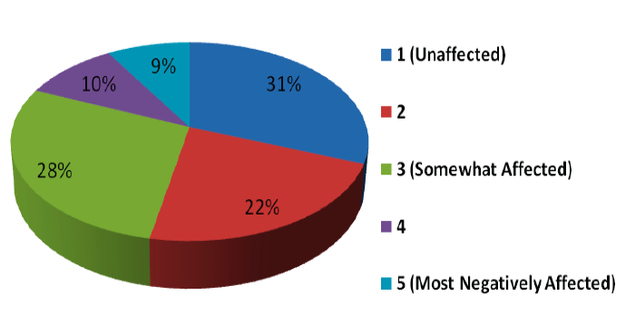
The survey was conducted in late November and early December with 90 people responding to the survey, and more information about the respondents and the survey can be found on the Online Community Report blog. Here’s a summary of the key findings.
Most communities have not been negatively impacted by the economy.
Image from OCRN
For those that have been effected, the hardest areas hit included.
Contractor staffing
Platform budget
Full time staffing
Communities are becoming MORE valuable to management.
When they asked:
Have your internal stakeholders (execs, management) attitudes toward the value of the online community changed because of current economic pressure?
Slightly more than half of the respondents (55%) said that their company internal stakeholder’s attitudes have changed towards the value of the online community because of the current economic pressure. For those whose stakeholder’s attitudes that had changed, over half of the respondents (55%) indicated that their internal stakeholder’s considered their online community more valuable because of the current economic pressures.
The current economic issues are hitting every segment, but it’s nice to know that online communities are faring better than some other areas. This post is just a quick summary of the key points, so I encourage you to read more details on Bill Johnston’s Online Community Report blog.
Yahoo Pipes can make it easier to work with location data (latitude / longitude) across multiple RSS feeds, even when the original feeds have different ways of specifying the location data. In this demo, I’ll show you how to use the Location Extracter module to normalize the data and then filter on lat / long data to get results only within a certain area.
Fetch Feed. In this example, we will use a feed from Shizzow containing information about places and a feed from the USGS with earthquake data. Both store their lat / long data in different ways within the RSS Feed.
Location extractor. This module is atypical, since it takes no parameters and has no user configurable elements. It simply looks for lat / long data and saves what it finds as y:location.lat and y:location.lon.
Sort. Sort by date (descending) to make sure that the output from your various source feeds appears in sorted order.
Filter. We then filter the source feeds to include only the entries located in the western part of the United States (25 < latitude < 50 and -130 < longitude < -115).
Pipe Output. The final module in every Yahoo Pipe.