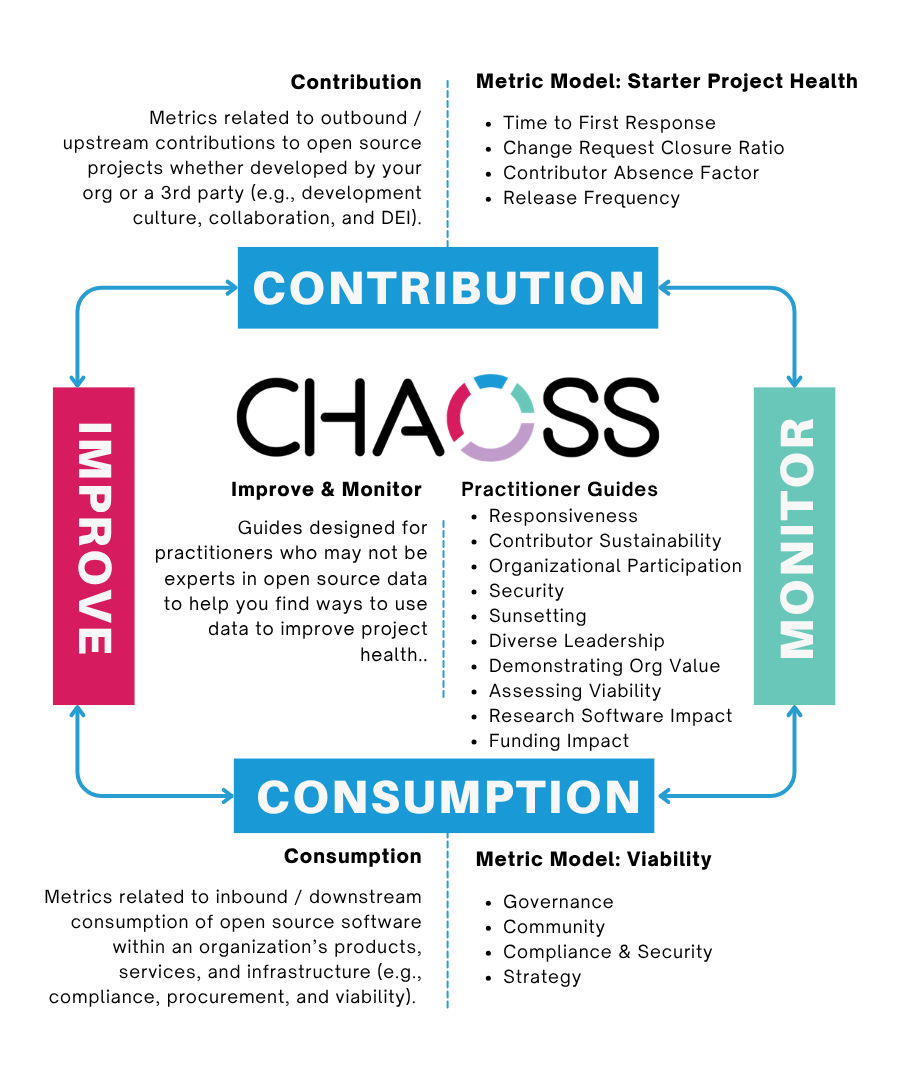
I’m excited to be leading the Roundtable Discussion at OpenChain x OSPOlogy Prague on October 6 on the topic of taking a Strategic Approach to Improving your OSPO using CHAOSS.
Metrics can provide deep insights into our open source initiatives, but they can also be overwhelming and require interpretation. Interpreting metrics and understanding what they mean is only useful if you drive appropriate actions to make decisions and improvements based on those metrics. In this roundtable, we’ll use a strategy first approach to discuss how to use metrics, tools, and practitioner guides from CHAOSS to improve the work within your OSPO whether you want to improve OSS projects themselves, assess their viability / risk for your organization, or demonstrate the value and impact of your OSPO.
Since this will be facilitated as a roundtable discussion, here are some links that participants (and anyone else) may find helpful.
I’m thrilled to share that the relicensing and forks research that Matt Germonprez and I have been working on over the past 3 years has finally been published in Information Systems Journal, an A-level academic publication! “Freeriding and Rebellion: An Investigation of Open Source Vendor Relicensing and Member Hard Forking Events” is available via open access for anyone to read, and I recommend viewing it in PDF format, since the table formatting is a bit better than in the web version.
Here’s the abstract if you want a preview before you give it a read:
Open source engagement is an ongoing effort in which members continuously interact with evolving project dynamics. Engagement extends beyond writing code or setting policy; it is a shared practice of understanding, negotiating, and adapting to the social and technical structures that define a project. As members continually evaluate their project engagement, collective action threats may arise that impact the overall functioning and sustainability of a project. In our research, we investigate collective action threats and governance practices in relation to a recent trend of vendor defined licence changes that result in project members creating hard forks. Drawing on a netnographic analysis of three cases, Elasticsearch → OpenSearch, Terraform → OpenTofu, and Redis → Valkey, we develop theoretical and practical insights into what collective action threats and governance practices are present, their relationships, and who is involved in them within open source projects that experience relicensing and related hard fork events. Our research provides theoretical and practical implications that show how freeriding accusations become the justification for unilateral, non-incremental adaptation to a project’s boundary regulation and how these governance changes are tied to rebellion as project members reposition themselves within shifting open source landscapes and realign their future open source project engagements.
This is the second place that the research has been published this month, since a short article on a related topic targeted at practitioners was also published in IEEE’s Computer: Value Capture Dynamics in Open Source (also open access).
This research has been a long road that started with me being curious about the organizational dynamics in open source projects that were forked when the original project moved under a proprietary license. I was involved briefly in the OpenSearch community in 2021, but when Valkey was forked from Redis in March 2024 (not long after the OpenTofu fork of Terraform in September 2023), I started gathering and analyzing data that I began sharing in presentations in the summer of 2024. This quickly turned into a short paper, The New Dynamics of Open Source: Relicensing, Forks, and Community Impact, which was presented at the OpenForum Academy (OFA) Symposium November 2024.
Those initial findings evolved as the forks evolved, and Matt Germonprez and I began thinking about the broader implications of these dynamics. We began giving presentations about power dynamics, rug pulls, and other corporate impacts on open source sustainability to get more feedback. There is a video from the Open Source Summit in August 2025 that you can watch on YouTube and Jon Corbett did a lovely job of summarizing it in his LWN Coverage of the talk. The idea was also turned into a blog post for The New Stack: Clouds, Code, and Control: The New Open Source Power Struggle.
After a couple of these presentations, Matt Germonprez and I started working on how we turn the data and these ideas into a published academic paper, which you can read today in Information Systems Journal. A huge thank you to Matt, since without him, I would not have been able to get this research published in an academic journal of this quality!
This may be the conclusion of this line of research, since we’ve both moved on to other areas of interest. I’m looking forward to seeing more of Matt’s continuing research into open source supply chains while I focus on consulting (I’m available for consulting engagements focused on open source strategy, contributor strategy, improving project governance, and related topics). I hope you enjoy reading more about our research!
Related links:
Foster, D., and Germonprez, M. 2026. “Freeriding and Rebellion: An Investigation of Open Source Vendor Relicensing and Member Hard Forking Events.” Information Systems Journal 1–31. https://doi.org/10.1111/isj.70060.
Foster, D. and Germonprez, M., 2026. “Value Capture Dynamics in Open Source,” in Computer, 59(9), pp.110-114, Available at https://doi.org/10.1109/MC.2026.3704794
Foster, D., 2024, ‘The New Dynamics of Open Source: Relicensing, Forks, and Community Impact’, paper presented to OpenForum Academy Symposium, Boston, Massachusetts, 13-14 November, Available at https://doi.org/10.48550/arXiv.2411.04739
I’m excited to be attending and presenting at my first ASF Community Over Code in October! It’s an event that I’ve always wanted to attend, but for whatever reason, I could never quite fit it into my schedule … until now.
Community Over / Code Glasgow 2026
This seems like the perfect time and place to deliver a brand new talk about what we can do to fix the leadership gap threatening open source projects. Anyone who knows me, or who regularly reads this blog, has seen that open source sustainability is an important topic for me, and open source needs sustainable leadership. We’re in a situation now where current leaders are burning out, retiring, or otherwise becoming unable to continue, which is creating a leadership gap with not enough new people having the opportunities or skills needed to move up within a project. The talk focuses on three topics: inclusive leadership principles, recruiting leaders, and good governance with a final section summarizing the actions that we can all take as individuals to fix the leadership gap. This blog post provides a preview of the talk.
Inclusive Leadership Principles
It’s important to have a variety of leadership roles that can act as a stepping stone to allow people to lead in smaller areas before moving to whatever you have as a top level leadership position. This can take the form of someone becoming a committer or reviewer, and then becoming maintainer. It might mean managing a community, leading documentation, managing projects, or becoming a chair of a working group, and then later moving on to a board or steering committee.
We’ve all seen projects where the same people sit in the same leadership positions year after year without providing opportunities for other contributors to move up within the project. If leadership positions aren’t available on a regular basis, then it can be difficult or impossible to promote people into leadership, which is why terms for boards or steering committees are important. Contributors can become disillusioned and disengaged if they don’t feel like there are enough opportunities within a project.
New and existing contributors feel more included when they can see other people in leadership positions who are like them. Without diverse leadership, underrepresented groups may face challenges in participating in and contributing to projects, losing valuable talent and ideas. It’s also important for people in leadership roles to role model good behavior and help others understand what behavior is appropriate within your project. Tolerating bad behavior unwittingly sets the expectation that this behavior is acceptable in your project, which can drive new and existing contributors away.
Recruiting Leaders
This is a hard problem to solve. Sometimes it can be really difficult to get people to contribute to your project, and unfortunately, there is no magic or one size fits all solution. Some people are contributing as part of their job while others might contribute to gain experience or learn something. Clear communication, working in the open, public roadmaps, having good onboarding documentation, and reducing friction are key to helping people stick around. Having good first issues or help wanted labels are excellent places to start because these help people find something that they can work on while they learn more about the project. But, good first issues and help wanted labels are passive requests for help, so I also encourage people to be proactive and specific about ways that people can help. Asking someone specific to review a PR or answer a question from a user demonstrates that you recognize their unique expertise and want their help. Knowing that we’re wanted and appreciated makes us feel good, which can be a strong motivator to contribute to an open source project or to continue contributing.
Defining the roles and responsibilities for contributors, reviewers, and maintainers can help with recruiting into these roles. It can help to think about this as a ladder where contributors can climb up to become reviewers and those reviewers can become maintainers. What’s important is to document it and make sure that people understand how they can climb the ladder and gain more responsibilities within the project. Having a contributor ladder helps set expectations for the roles and encourages people to think about how they might take on areas of increasing responsibility within the project. As you get more of the humans moving into maintainer roles, you can reduce the load of the existing maintainers.
Good Governance
Projects can work toward more inclusive leadership practices where people feel welcome and included in project leadership, but you also need to have good governance practices and processes that make it possible for people to feel included and move up within the project. Good governance is a key element in fixing the open source leadership gap. I actually have a second talk on this topic in the Governance and Policy track at Community Over Code, and I’ve covered governance extensively here on this blog, so I’ll just share a few highlights as they relate to the leadership gap.
The tricky thing about governance is that it needs to be proactive. The time to work on governance is when things are going well. If you wait until there is a crisis within your community, you might not have the right processes for dealing with that crisis, and when a project is in crisis, it will be much more difficult to come to an agreement about governance.
Governance is one of those things that is never really finished. The governance processes that you need when you have only a couple of maintainers is likely to be insufficient if the project grows dramatically. As your projects evolve, your governance and your leadership should evolve along with them. But changing your governance processes to evolve with the changing needs of the project can be hard. People have feelings and any kind of change can be difficult, but this is especially true in many open source projects where people often become deeply and personally invested in their projects.
Take Action
Fixing the leadership gap in open source won’t just happen without all of us taking action. Here are a few suggestions for what you can do as an individual to help ensure that open source projects have the leadership to be sustained over time.
One of the things we can all do, but especially those of you working in companies, is to provide funding for open source, which can help to reduce the pressure on open source maintainers and projects. It can provide a way to pay more people to devote their time to an open source project. You can donate to individual projects via platforms like Open Collective or GitHub Sponsors. You can contribute to things like the Open Source Pledge. You can fund open source research via the Software Stewardship Lab. There are many ways to fund open source, and that’s something that we can all do.
Those of us who are established in our careers and in open source projects can use our influence and reputation in a project to help others gain visibility and opportunities that eventually result in someone new moving into leadership positions. We call this sponsorship, which is more than just mentoring, and can include things like inviting someone to co-present or join a panel at an event, providing opportunities to collaborate together on some aspect of a project, or other activities that give people new opportunities to learn and lead.
I mentioned earlier that we’ve all seen projects where the same people sit in the same leadership positions year after year without providing opportunities for other contributors to move up within the project. If you’re one of those people, it might be time to take a hard look at whether you’re still providing the value to the project that you once did, or are you taking a space that could be offered to an up and coming person doing great work in the project?
This is something that I have personally been thinking hard about over the past several years, and I’ve started giving up leadership roles to allow other people to have the same opportunities I’ve had.
Summary
Fixing the leadership gap that is threatening open source project health and sustainability won’t just magically happen. It’s going to take work, and it’s going to require action from all of us, so take a hard look at the projects you’re involved in, and look critically at your own behavior. Think about how you can improve the governance for the projects you’re involved in and what you can do to improve inclusivity within those projects. Consider what you can do to help others move up within open source projects and how you can be a role model for leadership in open source. And most importantly, drive the change that you want to see.
If you want to attend this talk and other great talks on similar topics, I hope to see you at Community over Code in Glasgow October 11-14!
If you want feedback or help with sustainable leadership, governance, or related open source topics, I’m available for consulting engagements.
This final post in my series about using the CHAOSS Practitioner Guides focuses on determining impact for two specific cases: Funding Impact Measurement and Research Software Impact. If you haven’t already read the previous posts in the series, I encourage you to pause and read those first:
Much of the critical infrastructure that we all rely on is made up of open source projects that lack the resources to be properly maintained over the long term. Funders need to be able to understand the impacts of past funding in order to secure buy-in for future funding as well as adapting and/or innovating funding approaches whilst mitigating ineffective or even harmful approaches. We all benefit from more public institutions, philanthropic organizations, and companies giving money to open source; when done in a way that positive impact is the ultimate goal and objective.
Start by understanding the context. Accounting for funding objectives, project life stage and social structure, and regional and organizational cost factors is an important first step in measuring funding impact, since it provides important context.
Economic, social, and technological impacts can be both positive and negative, direct and indirect, internal (i.e. within a project) and external (i.e. among a project’s ecosystem of dependents and users), and manifest over various time horizons. When assessing the impacts of open source funding, there may be a tendency to focus on technological impacts, which may in part be due to the nature of open source or the relative ease of measuring data from repositories. However, the potential impacts of funding extend beyond the code itself, and it is crucial to consider economic and social impacts on projects and their wider ecosystems of dependents and users.
Methods. When it comes to measuring the impacts, funders can consider a breadth of methods for impact measurement. We recommend using a mixed methods approach, which provides a way to combine scalable quantitative measures along with contextual depth from qualitative data to better understand the funding impact.
This guide helps organizations measure the impact of their funding initiatives so that we can increase the funding to open source projects to drive future improvements and allow these projects, and the people working on them, to become healthier and more sustainable over time. Most of this guide came from a paper that I co-wrote with Cailean Osborne, Paul Sharratt, and Mirko Boehm, so a big thank you to my co-authors and others from the CHAOSS Funding Impact Working Group for supporting this guide!
Research Software Impact
Looking at the impact of research software requires a very different approach from the corporate context, so we have a guide dedicated to that topic: Practitioner Guide: Research Software Impact. Software and open source community work does not have a history of being part of reappointment, tenure, and promotion cases and has not represented a traditional outcome of university research work. To make this even more complicated, there are no consistent international practices for using software identifiers or citing software. A huge thanks to Matt Germonprez and Clare Dillon for writing this one!
The guide highlights the importance of open source software and community work as significant scholarly outputs using several metrics for determining research software impact:
Contributor Absence Factor. For researchers and evaluators, the contributor absence factor is helpful in understanding how an open source project is growing to include contributors who are responsible for more than 50% of the code base.
New Contributors. A steady influx of new contributors may indicate a healthy, inviting project, while declines can be a signal for potential challenges in engagement or accessibility.
Project Velocity. A researcher can use the Project Velocity metric to report project velocity of their own open source project and compare project velocity across a portfolio of projects.
Change Requests. The Change Requests metric tracks the proposals for modifications to a project’s source code that have been submitted for review during a given time frame.
There are also additional metrics, like software citations and external funding, that may be used if they are available.
The guide focuses on the impact of open source software and/or communities created and maintained by individuals and teams as part of their research role, including evaluators who are part of researcher reappointment, tenure, and promotion cases. This guide focuses on open source software and communities developed and maintained by a researcher or team to recognize the social and technical impact from that work.
Summary
These are very different guides that both focus on assessing impact within slightly niche topics that only apply in specific situations. However, they would also be useful when brainstorming ways to assess impact in other situations. As always, if you want feedback or help with open source strategy, sustainability, governance, or related open source topics, I’m available for consulting engagements. In particular, I’m interested in working with organizations who need help assessing the impact of their open source funding initiatives.
This post is focused on two of our more advanced / expert practitioner guides that help organizations look more holistically at open source initiatives that span across projects. This post is particularly relevant for Open Source Program Offices (OSPOs), but can be used by anyone focused on open source with a variety of different types of organizations. This post covers two more complex topics with guides that are much more extensive than the getting started guides:
Open source teams and OSPOs often experience pressure from leadership to drop and / or reduce their open source contributions to focus on internal initiatives that deliver more value to the organization. This puts open source teams in the position of needing to justify their work in open source to demonstrate that it has as much or more value than other initiatives that employees could be working on. However, it can be difficult to frame the justification in ways that resonate with leadership and clearly articulate how the organization benefits from continued contributions to an open source project. Thank you to Bob Killen for providing quite a bit of the content for this guide based on his experiences when he worked at Google.
Goals. Start by focusing on supporting your organization’s goals. The priority for investment (allocating staff or other resources) in open source can be framed as a combination of criticality and project health risk that is unique to your organization.
Criticality. Determine which open source projects are the most critical for your organization by looking at dependencies, opportunities to influence projects, and supportability of the projects you use.
Health Risk. Assess the project health risk of the open source projects that are important for your organization using a variety of metrics highlighted in the guide.
Priority. Prioritize within your limited resources using a combination of criticality and project health risk as determined above.
Value. Use all of this to measure and frame the value in ways that your leadership can see why contributions to certain projects are important to helping the organization achieve its goals.
One guide can’t possibly cover everything about demonstrating the value of your organization’s open source efforts, so this is just a fraction of the potential ways that open source investments can be tracked and tied back to goals while effectively describing the value of the contributions. It requires the right framing and ensuring that resources are allocated where they may have the most value; however, the framing and resource allocation will be different in almost every situation, since it depends on your organization’s unique needs.
Assessing Viability
Evaluating the viability and the risk that comes with specific open source projects is important to avoid disruptions that hamper the ability for your organization to deliver products and services to customers, especially when a key dependency suddenly becomes unviable. Assessing the viability of open source projects, especially ones that have the potential to impact the business, is a good first step toward managing risk and reducing the chances of potential business disruptions. A huge thank you to Gary White for writing most of the content in this guide based on his viability assessment experiences within the Verizon OSPO.
Compliance and Security assesses a project’s licensing fit, vulnerability risk, and maintenance activities. It is important for users to comply with any responsibilities they may hold to an organization or to the creators of a project.
Governance metrics are useful to show the intention or lack of intention in the project’s governance and help define decision-making processes. The ability to contribute, understand, or depend on a project is highly coupled to the effort behind governance.
Community metrics indicate how the community maintains a project and how much interest there is generally. A key aspect of viability is community activity and adoption, because without an active community, an open source project is not likely to continue to evolve and grow. The idea is that an active community surrounding a project is more likely to drive better performance, vulnerability management, and feature-completeness to ease development downstream.
Strategy metrics help to determine the influence that individuals and organizations have within a project.
Organizations should be thinking strategically about project risks in light of how they are using the projects. If it’s a critical part of a technology stack, it should be as low of a risk as possible. On the other hand, if an open source project is used as a small part of some non-critical infrastructure, an organization can accept more risk. Assessing viability and thinking about it from the perspective of risk and which risks to accept is an important first step, but it’s also important to think about which risks can be mitigated to improve viability. The best way to mitigate many of these risks is by paying employees to contribute to the projects that are most important to your organization. This provides an opportunity to improve viability and sustainability, but it also provides insight into where the project is heading and how things are going, so that if something changes in the project to further increase risk, it might be easier to anticipate those changes.
Summary
Determining value and assessing viability are topics that may seem distinct, but quickly become intertwined, especially within OSPOs. When determining value, one step is to look at how important or critical the project is within your organization. Those critical or strategic projects should also get a viability assessment, which can help to determine project health, which is the other side of the value equation in the guide. Both of these guides used together can help your organization justify the value of your open source contributions both from the strategic side (organizational value) and for understanding and mitigating risks (viability). Check back next week for the final post in this series, Part 4: Assessing Impact Using CHAOSS Practitioner Guides.
As always, if you want help with either of these topics or more generally need advice or feedback on open source strategy, sustainability, governance, or related open source topics, I’m available for consulting engagements.
This is the second post in a series, so I encourage you to go back to read the previous post about Building Healthy and Sustainable Projects Using CHAOSS Practitioner Guides if you haven’t already read it. The first post covered the introduction, contributor sustainability, responsiveness, and organizational participation, which were the original 4 guides in the series.
Shortly after we launched the Practitioner Guide series, we followed up with three additional getting started guides on security, diverse leadership, and sunsetting a project. As I mentioned in the first post in this series, starting with the Practitioner Guide: Introduction – Things to Think about When Interpreting Metrics can help interpret metrics in light of your unique situation. Again, interpreting the metrics and figuring out what they are telling you is only useful if you take the additional step of driving appropriate actions to make decisions and improvements based on those metrics, and each guide provides recommended actions.
Security
Open source project security impacts the health and sustainability for our projects, which ripples out across the entire software ecosystem as dependency / supply chain components. Because security is a complex and critical topic, this Practitioner Guide: Getting Started with Security is designed only to get you started on your path toward improving the security of your project; it is not a comprehensive guide to everything you need to know about open source project security. The guide has suggested starter metrics that include OpenSSF Best Practices Badge, Libyears, and Release Frequency along with additional metrics that might also shed light on the security of a project.
Recommendations for improvement from the security guide include:
Secure your code repository by managing access, implementing branch protection, managing contributions, and more.
Create a detailed security policy document (usually in a SECURITY.md file) with instructions for reporting security vulnerabilities along with documenting how the project will respond to those reports, including managing embargoes.
Keep your dependencies up to date and use tooling (e.g., Dependabot) to help identify and update your dependencies.
Make sure that your security fixes land in a release as soon as possible.
Working your way through the OpenSSF Best Practices badge criteria is also a good way to make security improvements.
Diverse Leadership
Without diverse leadership, underrepresented groups may face challenges in participating in and contributing to projects, losing valuable talent and ideas, so a huge thank you to Peculiar C. Umeh who drove the creation of the Practitioner Guide: Getting Started with Building Diverse Leadership! The guide focuses on three key metrics: Board/Council Diversity, Sponsorship (supporting people, not financial sponsorship), and Inclusive Leadership. The data collected can provide valuable insight, but storing, interpreting, and acting upon it requires careful thought to protect identities and be respectful of the people whose data has been collected.
Actions to take include to improve diverse leadership:
Start by creating and communicating clear pathways for contributors to grow into leadership roles, which may include creating sponsorship opportunities and transparent criteria for leadership positions.
Hold existing leaders accountable for promoting and improving inclusive leadership.
Implement programs that encourage diverse representation in leadership and promote diverse perspectives.
Regularly monitor and evaluate the diversity of all leadership roles by collecting and analyzing survey data and reporting progress to the community.
This was a challenging guide to write, and it can be a challenge to implement these recommendations. Open source communities are often global and encompass diverse people and backgrounds, so there is a need to avoid imposing a one-size-fits-all approach and be open to adapting strategies to fit the unique needs and values of different groups within your community. Each project should ensure that their practices are inclusive, making all members feel heard and valued, regardless of their background or identity.
Sunsetting (Winding Down and Archiving)
The Practitioner Guide: Getting Started with Sunsetting an Open Source Project is quite different from the other getting started guides because it’s not about making project health improvements or increasing sustainability, but instead about responsibly and proactively shutting a project down when it’s reached a natural end. It’s important to remember that not every open source project can or should exist forever: technologies evolve, corporate priorities change, and people’s interests change. Part of the beauty of open source is that we work in the open as we innovate, and some of those innovative projects will stand the test of time, while others should be responsibly deprecated via a sunset process. The guide looks at several metrics to determine whether a project is still active, Change Requests, Issues New, and Technical Forks, but the guide also covers other reasons for sunsetting a project.
Once you’ve decided to sunset a project, there are several recommended steps:
Communication should start with any existing contributors, since there may be contributors who would like to continue the project. When you decide to sunset the project, this needs to be communicated to existing users in a transparent manner and being clear about the reasons for sunsetting it.
Do a code and security review to get it into the best possible shape before archival.
Review and resolve open issues and change requests (PRs / Merge Requests), including marking some as ‘won’t fix’.
Use the checklists and tools linked from the guide to help with this work.
Officially archive the repositories and consider adding the code to Software Heritage for preservation over time.
There are also recommendations for handling the special case of sunsetting an active project, which can happen when a company changes strategy or when an individual needs to step away.
Sunsetting a project is not an indication of failure and should not be positioned as such. Projects have life cycles; they endure for as long as they are needed and then they should be responsibly deprecated when they are no longer needed. Consider providing transition details, and if possible, tooling that helps your existing users transition to an alternative solution if a reasonable one is available. I’d also like to express my thanks to Stefka Dimitrova whose work drove much of the content in the guide and to the team from the US Centers for Medicare & Medicaid Services OSPO who made significant contributions and improvements to the sunsetting guide.
Summary
Improving open source project security and increasing diverse leadership can help a project become more sustainable over time, but when a project has reached the end, it can be responsibly sunsetted, instead of being abandoned. The CHAOSS Practitioner Guide series can help with all of these activities. Come back next week for the next post in this series, ‘Part 3: Determining Value and Viability Using CHAOSS Practitioner Guides’.
As always, if you want feedback or help with open source strategy, sustainability, governance, or related open source topics, I’m available for consulting engagements.
Metrics can provide deep insights into our open source projects, but they can also be overwhelming, and because every open source project and every situation is a bit different, metrics require interpretation. And that’s only the first step. Interpreting the metrics and figuring out what they are telling you is only useful if you take the additional step of driving appropriate actions to make decisions and improvements based on those metrics. I’ve been working in open source and using metrics for decades, but for me the metrics have never been what’s important. They are simply the means to an end, a way to make improvements or demonstrate whether we are accomplishing our goals.
This is why I focused on creating the CHAOSS Practitioner Guide series during my three years as CHAOSS Director of Data Science, and I’m proud of what we, as a community, accomplished with these guides. I’ve written quite a few blog posts about the individual guides, but I wanted to take some time here to reflect on the guides and talk about how they can be used together as a cohesive whole. The guides roughly break into two categories, which I’ll address in a series of four blog posts. The first category focuses on health and sustainability of open source projects. This post is about the first category, ‘Building Healthy and Sustainable Open Source Projects’, with part 2 coming next week to cover ‘Additional Sustainability Topics From the CHAOSS Practitioner Guides’. The second category of guides are the more advanced ones dealing with complex topics, like value, viability, and impact, that span multiple projects. Part 3 in the series focuses on value and viability while part 4 will cover determining impact.
The guides are paired with as ‘Introduction – Things to Think about When Interpreting Metrics’ as a starting guide with more details about how to interpret metrics in light of your unique situation. The introduction has general suggestions about how you should spend time understanding the goals of the project and talking to the people working within the project as key inputs into interpreting metrics. When it comes time to look at the metrics, focusing on trends over time for just a few metrics can help cut through the noise before drilling down into the details where there might be a potential issue. This is why each getting started guide focuses on just a few metrics to get started with tips for expanding to additional metrics as needed.
Every project is a little different, so it’s essential to interpret the metrics in light of a project’s individual needs and ways of operating. It’s also important to remember that metrics are more than just data, they represent actual human beings, so it’s important to be careful about comparing people against each other in ways that might result in the punishment of individuals. The non-human data (e.g., bots, automation, AI) should also be carefully taken into account in your interpretation of metrics. The Introduction – Things to Think about When Interpreting Metrics guide has more details about how to think about metrics and use what you’ve learned productively and ethically.
Contributor Sustainability
The Practitioner Guide: Getting Started with Contributor Sustainability focuses not just on determining whether you have enough contributors to sustain a project over the long-term, it also has tips for increasing contributor sustainability while keeping in mind that new contributors can also create additional burdens on the time of already overloaded maintainers. The guide includes Contributor Absence Factor, Contributors, and Types of Contributions as the key metrics to start investigating contributor sustainability.
Start by looking at your existing contributor base to determine whether you have people who are ready to step into a maintainer role, even if they start by maintaining just a sub-project. If there are people who are almost ready, some mentoring or reviewer roles might be a good first step.
Before starting to recruit new contributors, it might help to review and update existing contributor guides and other onboarding documentation to help people get up to speed quickly while requiring less help from existing maintainers.
Good first issues and help wanted labels can help new contributors get started on something productive, especially if those issues are created with the information that a new contributor needs to know to accomplish the task.
Be proactive about asking people for help with specific tasks. Knowing that we’re wanted and appreciated makes us feel good, which can be a strong motivator to contribute to an open source project or to continue contributing.
Defining the roles and responsibilities for contributors, reviewers, and maintainers as a contributor ladder where contributors can climb up to become reviewers and those reviewers can become maintainers can help with recruiting new people into these roles.
Think about how people can move into leadership positions to be responsible for documentation, community management, marketing and other important roles.
Responsiveness
Responsiveness is one of the most important factors in attracting newcomers and retaining existing contributors for a project. The Practitioner Guide: Getting Started with Responsiveness uses Time to First Response, Time to Close, and Change Request Closure Ratio as the key metrics to help determine whether a project is responding to requests in a timely manner. It can be tempting to attempt to solve issues with responsiveness by putting more pressure on existing maintainers by asking them to respond more quickly and resolve more contributions, but this rarely solves the long-term problem. It might result in short-term gains, but it could be damaging to the community and the project over time if you are burning out your maintainers by not resolving the underlying problems that are causing the lack of responsiveness in the first place.
Some suggestions for improving responsiveness from the guide include:
As suggested in the contributor sustainability guide, start by looking at whether you can promote some existing contributors into reviewer or maintainer roles.
Use the project’s contributing documentation to set expectations about when to expect a response to a contribution.
Use issue and change request templates to help contributors make good contributions that require less work from maintainers.
Talk to your maintainers and find out where they are spending too much of their time and focus documentation or recruitment in those targeted areas.
Note that responsiveness is hard to diagnose because many things can impact responsiveness, so don’t be discouraged if your first attempt doesn’t result in improvement.
Organizational Participation
Organizations can have a significant impact on the health and sustainability of an open source project. On the one hand, organizations can help sustain projects over time by employing people to work on projects, but they also introduce risk (e.g., from relicensing, strategy shifts, acquisitions) when one organization is too dominant. From a contribution standpoint, it can be difficult if one organization has all of the influence and other people don’t feel like they are participating as equals.
The recommendations for improving organizational participation depend on whether the improvement is coming from the dominant organization. From the dominant organization:
Contribution documents should be clear about whether contributions are accepted from people outside of the organization and whether those people can move into leadership positions. Transparency and setting expectations can reduce frustration from other contributors.
Spend some time thinking about why the project isn’t getting contributions from other organizations. Is all of the work happening in the open, and can others easily find decisions and discussions in public channels? If not, some work might be required to redirect private conversations into the public channels.
Promote opportunities to contribute via social media, conferences, and other channels.
Use your existing connections to other organizations who are using the project to encourage specific people to contribute.
From outside of the dominant organization:
Engage in the project to determine whether contributions are really welcome.
If so, encourage your employees to contribute to the project as part of their time at work. Don’t expect employees to contribute to work projects in their free time.
Being transparent is critical. Saying one thing in the documentation and doing another can damage your organization’s reputation more than just being honest and transparent about how people can (or cannot) contribute to a project. If you are considering using an open source project as a key component of your organization’s products or infrastructure, you should think very carefully about that decision when that project is controlled by a single organization.
Summary
Increasing contributor sustainability, improving responsiveness, and garnering participation from a variety of organizations can all help improve the health and sustainability for an open source project. Check back next week for the second blog post in this series about security, diverse leadership, and sunsetting an open source project.
As always, if you want feedback or help with open source strategy, sustainability, governance, or related open source topics, I’m available for consulting engagements.
OSPOs and other open source teams often struggle to demonstrate the value of their work in a way that resonates with the people in leadership positions within their organization. The topic of demonstrating open source value is one that I’ve been blogging about and giving presentations about frequently over the past year, so this blog post is a way for me to collect all of that work in one place to make it easier for people to find.
In the CHAOSS OSPO Working Group, which I co-chair, the topic of how to demonstrate the value of our work in open source has been a popular topic since we started the group many years ago. However, given the current financial climate and the number of OSPOs that have been the targets of cutbacks and layoffs, this feels like a particularly important topic right now. This is why we created a CHAOSS Practitioner Guide all about Demonstrating Organizational Value, which I blogged about when the guide was launched. In a second blog post on the topic, More about Demonstrating Organizational Value, I talked about the episode of CHAOSScast where Bob Killen and I joined Harmony Elendu to share our thoughts about how organizations can more effectively demonstrate the value of their open source efforts.
I expanded on this topic in another blog post, OSPO Contribution Strategies to Demonstrate Value. This post highlights how to articulate the importance of your contributions to upstream projects as part of a broader open source strategy, which often has 2 components: 1) identifying which projects are most strategic / critical for your organization and 2) creating contribution strategies for individual projects. The blog post has examples of how I did this when I worked at VMware and Pivotal.
I’ve also presented on this topic several times recently, but I wanted to highlight the two most recent talks, since they are the most comprehensive examples of these presentations. I blogged about my talk for the folks from CURIOSS (Community for University and Research Institution OSPOs) where I expanded on the content in the guide to also include more about how to demonstrate value in a university context. I further expanded it beyond corporate and university contexts to include how government / public sector organizations can demonstrate the value of their work in my talk at the Open Source Summit in Minneapolis a few weeks ago. Here’s the video and slides for this most recent version of the talk.
If you want feedback or help with your open source strategy and how to demonstrate value for your organization, I’m available for consulting engagements.
So much of the critical infrastructure that we all rely on contains open source projects that are under-resourced and struggling. One (of many) ways to help these projects is by funding development and maintenance so that contributors can focus on this work, but times are tough. Organizations and OSPOs are feeling the pinch, and it can be hard to justify continuing to fund open source projects. Measuring the impact of open source funding is something that I’m passionate about because the best way to continue to get leadership to give you money to fund open source is by showing them the impact of that funding.
However, measuring the impact of funding isn’t easy, and there is no one approach, since the goals and objectives for funding vary widely for different types of funding organizations and different open source projects. It’s also important to consider that not all funding provides positive outcomes, since money can introduce tension within projects. In 2024 to help organizations navigate these challenges, I collaborated with several people to write an academic paper on this topic: A Toolkit for Measuring the Impacts of Public Funding on Open Source Software Development. We recently turned this paper into the CHAOSS Practitioner Guide: Funding Impact Measurement, which is much shorter and focused on practical steps that organizations can take to justify the impact of funding provided to open source projects and maintainers.
The guide talks about the challenges of funding and the lessons we’ve learned along the way in addition to a section to help you navigate the actions that you can take to measure the impact. The “How to Take Action” section of the guide has three sections.
First, start by understanding the context. This includes understanding the funding objectives and how the funding is structured for the projects being funded, considering project life stages and social structures, and accounting for salary structures and cost factors for different types of contributors across multiple regions.
Second, look at economic, social, and technological impacts across multiple dimensions. The potential social, economic, and technological impacts can be both positive and negative, direct and indirect, internal (i.e. within a project) and external (i.e. ecosystem), and manifest over different time horizons. The guide contains examples of how to think about each of these areas.
Third, using various methods to combine scalable quantitative measures along with contextual depth from qualitative data to better understand the funding impact. Mixed-methods approaches offer the best of both words: scalability and contextual depth. The guide and the paper have more details about how to do this.
This post doesn’t tell you how to justify getting new funding for open source efforts, so if you want to start funding open source projects, you need to demonstrate the value of that work to your leadership. There is a Demonstrating Organizational Value practitioner guide, and I’ve talked about demonstrating organizational value in several posts on this blog, which are linked in the “Related Resources” section below to provide a starting point. However, even if you haven’t yet started funding projects, you can still put together a plan for how you’ll measure the impact of that funding as part of demonstrating the value and making a case to your leadership along with the funding request.
I’ll conclude with a short quote from the guide:
“Funders need to be able to understand the impacts of past funding in order to secure buy-in for future funding as well as to adapting and/or innovating funding approaches whilst mitigating ineffective or even harmful approaches. We all benefit from more public institutions, philanthropic organizations, and companies giving money to open source; when done in a way that positive impact is the ultimate goal and objective. We hope that this guide helps organizations measure the impact of their funding initiatives so that we can increase the funding to open source projects to drive future improvements and allow these projects, and the people working on them, to become healthier and more sustainable over time.”
If you want help with measuring the impact of your funding or with other OSPO strategy topics, I’m available for consulting engagements.
Osborne, C., Sharratt, P., Foster, D., Boehm, M., 2024, ‘A Toolkit for Measuring the Impacts of Public Funding on Open Source Software Development’, paper presented to OpenForum Academy Symposium, Boston, Massachusetts, 13-14 November, Available at https://doi.org/10.48550/arXiv.2411.06027
The lovely folks from CURIOSS (Community for University and Research Institution OSPOs) invited me to join them in March as part of their Deep Dive series of talks. I gave a quick overview of CHAOSS before diving into one of my favorite topics: demonstrating the value of open source efforts. This is the first time I’ve given this talk with some additional content about how to demonstrate value in a university / academic context, which is a bit different from how we think about value in corporate environments.
The slides and video are available for you to enjoy!

![Hero image for Roundtable Discussion: [GROUP B] Strategic Approach to Improving your OSPO using CHAOSS. MENTOR: Dawn Foster (TODO Group Ambassador). October 6, 2026. 13:40 - 14:40. Deloitte Offices. OpenChain X OSPOlogy Prague 2026.](https://fastwonderblog.com/wp-content/uploads/2026/09/07-roundtable-chaoss.png)