Transitions

TL;DR version: As planned, my time as the CHAOSS Director of Data Science has come to an end, but I’ll still be around the CHAOSS community as a board member and Working Group (WG) lead. I’ll be taking April and most of May off before transitioning into open source strategy consulting starting in June.

The CHAOSS Director of Data Science role was funded by an Alfred P. Sloan Foundation grant for 3 years, so the plan was always to move on to something else when it ended in March 2026. I’m very proud of what we’ve accomplished in 3 years, so a huge thank you to the folks at the Sloan Foundation for the funding that allowed me to focus on this over the past few years. When I started this work, one of the first steps was to create the CHAOSS Data Science WG, which has allowed us to grow the data science community. We started the Practitioner Guide series within the WG and have published almost a dozen guides on a wide variety of topics! We also launched several research projects in addition to the Relicensing and Forks project that I’ve been focused on over the past few years. You can learn more about what we’ve accomplished by reading our updates from January 2025, June 2025, and November 2025. I feel confident that the CHAOSS data science community and the WG are in good hands as I step down and leave the work in the very capable hands of the other 2 co-chairs, Cali Dolfi and Sal Kimmich, and maintainer, Ernest Owojori.

However, I’m not leaving the CHAOSS community. I’ll still be on the CHAOSS Governing Board and will continue co-chairing the OSPO WG, Funding Impact Measurement WG, and the Education WG. All of these WGs have co-chairs, so WG meetings will continue and nothing should change while I’m enjoying some time off to rest and recharge in April and May. The only exception to my time off is to attend the Open Source Summit in Minneapolis in May, since I didn’t want to miss it. I’m disappointed to need to say this, but I also wanted to make sure people know that this transition and the time off has been planned for over a year and has nothing to do with the current drama unfolding in the CHAOSS project this week.

What’s next? While I’ve enjoyed being able to focus on data and metrics over the past few years, I’ve found that I missed working on open source strategy, which has been my focus over the past two decades. The data science work was a fun diversion, but now I’m ready to get back to my roots. Starting in June, I’ll be shifting into open source strategy consulting. This is NOT a temporary solution while I figure out what to do next. My plan is to continue consulting on a part-time basis while I free up some time for my other hobbies (reading, working out / running, designing 3D prints, traveling), and to continue to do this for as long as I remain able to work. 

You can learn more about my consulting business on my consulting website, but here are a few focus areas:

  • Open Source Strategy: Crafting strategies for your OSPO, open source teams, or product teams that help employees focus their open source work in areas with the most impact along with demonstrating the value of your open source efforts to your executive team.
  • Contributor and Community Strategy: Strategies and techniques for growing your contributor base and improving sustainability for the open source projects driven by your organization and when working upstream.
  • Governance: Documenting and improving project governance processes for open source projects along with providing advice when there are governance issues or concerns.
  • Research and Data Analysis: Open to a variety of research and data projects to answer questions you have about open source projects from understanding an existing contributor base to doing audits of your GitHub organizations to understand the status of your repositories.

If you’d like my help in any of these areas, please reach out to me in June!

Reflections from FOSS Backstage 2026

FOSS Backstage is one of my favorite conferences, and again this year, I had an amazing experience. I saw interesting talks, caught up with friends, met new people, and still missed talking to a few people!

As with most conferences in Europe, digital sovereignty was a hot topic with quite a few talks touching on various aspects of the topic. Mirko Boehm talked about the role that open source can play in digital sovereignty, but it’s not quite so simple, since it requires participation in addition to adoption. Nicholas Gates gave a nice overview of the OSOR Report on Open Source in European Local Governments. Jan Lehnardt talked about the Sovereign Tech Agency’s Bug Bounty program. Andy Piper introduced how Digital Public Goods (DPGs), like Mastodon, can be part of a digital sovereignty strategy. Jutta Kreyss had a very interesting talk about how the city of Munich has approached measuring digital sovereignty. Dr. Daniel Gerber talked about how a FOSS foundation is working with the state of Saxony in Germany.

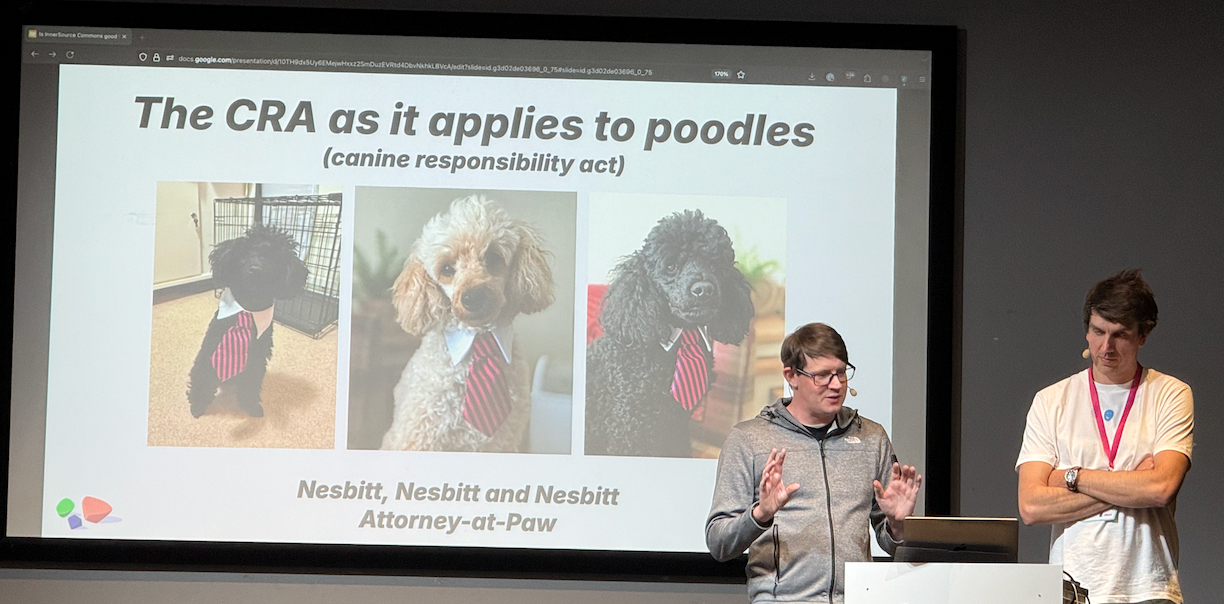
Slide with 3 poodles in little red and black striped ties with white collars. Text reads: The CRA (canine responsibility act) as it applies to poodles. Nesbitt, Nesbitt, and Nesbitt Attorney-at-Paw. Andrew Nesbitt and Ben Nickolls standing on either side of the podium at FOSS Backstage 2026.

There were also many other interesting talks on other topics. Æva Black used an interesting story telling approach to cover some historical inflection points and what we can learn from them to improve the security of open source as we learn how to comply with the Cyber Resilience Act. Dr. Wolfgang Gehring shared some of what they’ve learned running an inner source program at Mercedes-Benz. Benjamin Nickolls and Andrew Nesbitt talked about how they dove into some ecosyste.ms data in an attempt to answer the question, “Is the InnerSource Commons good for open source?”, which they asked during a talk at last year’s FOSS Backstage event. Max Mehl and Cornelius Schumacher focused on the supply chain but by looking at how to balance risk, value, and people with the OSPO sitting at the intersection of all three. I also moderated a panel with Peculiar C. Umeh, Ruth Ikegah, and Stephen Walli to talk about educating the next generation of open source contributors.

These are just a few of the talks that I attended, and I heard that some of the talks I missed were also great! Videos of most or of the talks should be available soon, so I encourage you to have a look when they are published!

Related Resources:

If you want help with your open source strategy, I’m available for consulting engagements.

Keynote image of Æva Black by the FOSS Backstage photographer. 

Power Dynamics, Rug Pulls, and Other Corporate Impacts on OSS Sustainability at SCALE 2026

As many of you know, this isn’t a new topic for me. I’ve written here about what your OSPO can do about power dynamics, rug pulls, and other corporate impacts on OSS sustainability along with a post on the OpenUK blog, The Shifting Power Dynamics in Open Source: Rug Pulls, Relicensing and Forks, and on The New Stack, Clouds, Code, and Control: The New Open Source Power Struggle. I’ve also given other presentations on this topic, so you can watch the video from the recent Open Source Summit EU (OSSEU) in Amsterdam, which Jon Corbett did a lovely job of summarizing in his LWN Coverage of the talk

I’ve been continuing to think about how power dynamics and rug pulls impact OSS sustainability, and I had an opportunity to talk about this at SCALE 2026 in Pasadena last weekend! I already blogged about how much I love SCALE, so I won’t continue to gush about how great it is. SCALE gave me a bit more time than I’ve had for the other presentations, so I added some new slides about other types of rug pulls beyond the relicensing and forks that I’ve previously focused on. I talked more about MongoDB, which kicked off the recent wave of relicensing when they relicensed under the newly created Server Side Public License (SSPL), which didn’t result in a fork. I also talked about some examples of rug pulls that came about when images / releases were put behind a paywall (Bitnami / Linkerd). My slides are a bit sparse, but available, and SCALE will also release the video of the talk if you want more details.

Resources:

I’m available for consulting engagements focused on open source strategy, contributor strategy, improving project governance, and related topics.

Podcast: What Does a Healthy OSPO Actually Look Like?

I’ve been spending quite a bit of time recently reflecting on how Open Source Program Offices (OSPOs) and our work in open source is evolving in a world where most of us don’t have as many resources as we need to support our open source work while at the same time, we’re experiencing an increasing reliance on open source as a key strategy for digital sovereignty. I started doing open source strategy work back in the very early 2000s at Intel, and in the 5 years before CHAOSS, I was in open source strategy roles at Pivotal and later VMware, so I’m looking forward to spending more time working with OSPOs as a consultant

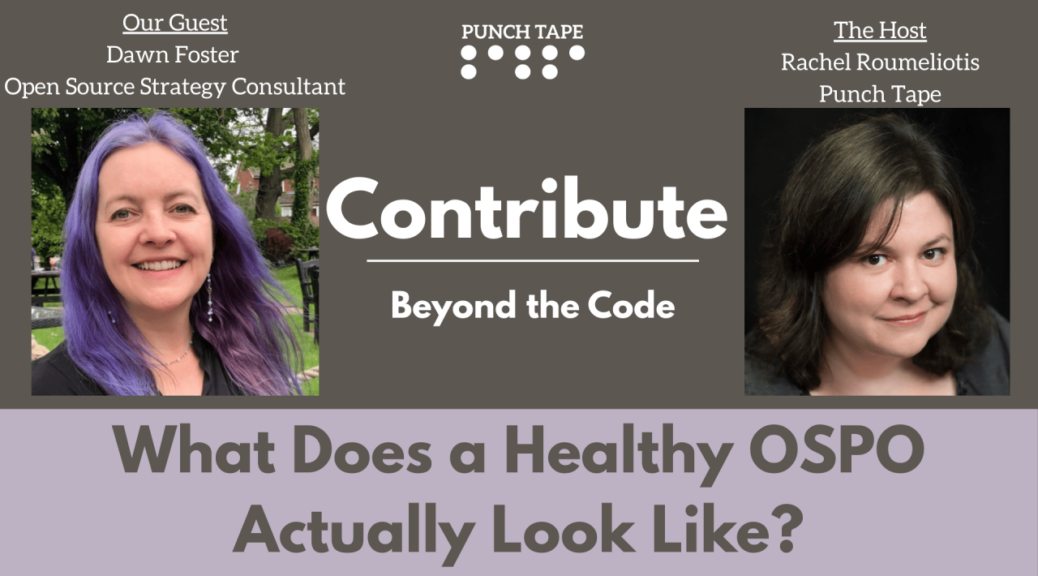
My recent conversation with Rachel on the Contribute: Beyond the Code podcast was a great excuse to reflect on some of what I’ve been thinking and writing about related to OSPOs. You can watch the full episode on YouTube, Apple, or Spotify.

We talked about how OSPOs can:

  • demonstrate the value of open source work within an organization.
  • have a bigger impact in open source when they go beyond compliance 
  • scale their efforts through documentation
  • balance internal enablement along with external engagement
  • track the most strategic open source projects for your organization
  • responsibly sunset (archive) open source projects
  • develop processes that make it easy for employees to engage in open source

Additional Reading: