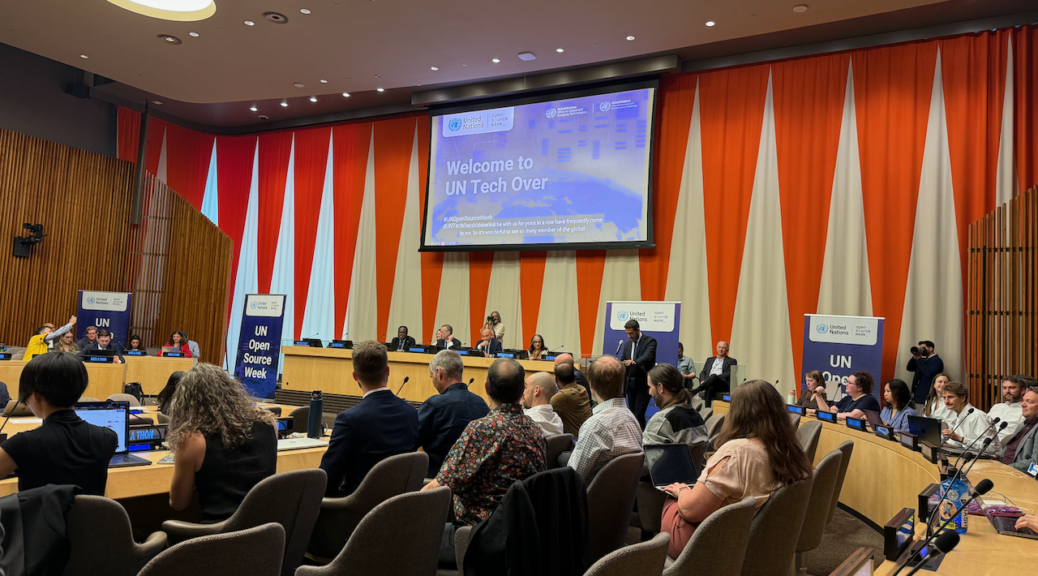
I’ve been fortunate to be able to attend the UN Open Source Week event again this year at the United Nations Headquarters in New York City where they bring the open source community together with government and policy folks to facilitate collaboration and information sharing. For these first several days, the overarching theme is around digital sovereignty with people seeing open source as a way to build public goods together. There were concerns about how technology has been consolidated into the hands of a few, but that open source and events like this one help us change that by embracing the freedom that open source offers. AI is seen as both an opportunity and a challenge with some AI cheerleading, while also expressing concerns that AI is trained mostly on the work of a few with many people not being represented in the training data. Overall, open source is seen as a partnership model to allow all of us to build public goods together.

One of my favorite things about this event is how people use it as an opportunity to get people together outside of the main event. While it may not seem like FOSDEM and a UN event would have much in common, they both have many side events that spring up to take advantage of the people they bring together. Like with FOSDEM, some of my best moments at the event have been during the conversations that I’ve been having with other open source folks during breaks, lunch, parties, and the hallway track!
The first day, I took advantage of the Maintainathon, which was part of the main program, but was organized separately by the Sovereign Tech Agency (STA) who brought an entire maintainer delegation with them to the event. It was great seeing people talking and collaborating around the specific concerns that maintainers have ranging from governance issues to more technical concerns. This was covered well already in the STA’s LinkedIn post.
My Tuesday started with a breakfast hosted by the STA at the German House. We had short remarks from Sovereign Tech Agency Managing Director Adriana Groh, Parliamentary State Secretary Thomas Jarzombek from Germany’s Federal Ministry for Digital Transformation and Government Modernisation, Amandeep Gill, UN Under-Secretary-General and Special Envoy for Digital and Emerging Technologies, Dr. Wolfgang Gehring, OSPO Lead at Mercedes-Benz Tech Innovation, Bastien Guerry, Head of Partnerships at Software Heritage, and Tiffany Farriss, CEO of Palantir.net and longtime Drupal Association board member. You can read more in the STA LinkedIn post about the breakfast.
On Wednesday, I was invited by the CURIOSS crew to their side event hosted at the Alfred P. Sloan Foundation offices as a special guest where we had some really interesting demos and discussions about measuring open source impact for academic OSPOs.
A few of us from CHAOSS started the day on Thursday with a breakfast meetup at a nearby coffee shop where I got to have interesting conversations with some awesome CHAOTICs before the main event!
OSPOs for Good
Thursday is the OSPOs for Good day, which is the main reason that I attend the UN Open Source Week. Again, the overarching theme has been about digital sovereignty.
It started with a few keynotes. H.E. Amal El Fallah Seghrouchni, Minister Delegate in charge of Digital Transition and Administrative Reform, Kingdom of Morocco talked about how open source plays a fundamental role for long-term control of critical digital services to produce contextualized solutions to meet the needs of Moroccan people and are making strategic investments in open source to benefit from international cooperation while remaining in control of their future. Angellah Jasmin Kairuki, Minister of Communication and IT, United Republic of Tanzania spoke about how OSPOs allow governments to share and reuse what works for digital public goods with open source as a critical trigger for digital sovereignty that puts citizens first to change the posture from passive consumers. Bernardo Mariano Junior, Assistant Secretary-General and Chief Information Technology Officer, UN Office of Information and Communications Technology talked about how this event brings open source passion to the united nations from across the globe with open source as a strategic enabler allowing us to move faster toward digital sovereignty. Jim Zemlin, CEO of The Linux Foundation talked about AI and open source making similar points as what he delivered in the recent Open Source Summit North America. Louise McKeever, Chief Information Officer, Department of Agriculture, Food, & the Marine in Ireland spoke about their policy of open source first and how open source provides transparency, flexibility, and resilience for digital sovereignty.
Up next in the main room was a panel about Open Source and Digital Sovereignty in a Connected World moderated by Ruth Suehle who opened by talking about how the UN charter reflects open source principles. Sachiko Muto talked about how open source is coming to the top of the agenda again as it has been before, but now public sector OSPOs are the key to turning these endorsements of open source into operational capability to make it a reality. OSPOs unlock the ability to collaborate across both private and public sectors with public sector OSPOs playing a key role. Adriana Groh spoke about how the STA shows that the government can play a role in supporting the open source ecosystem via public money for public code, but there is also a need to be able to demonstrate impact for how you’re spending public money. Volunteers don’t maintain public infrastructure, like roads and bridges, so we shouldn’t expect them to maintain our critical digital infrastructure, either. Frank Karlitschek talked about how open source is strategic and critical in today’s geopolitical environment, but challenges for adoption are not technical. Arun Gupta spoke about OSPOs as a catalyst for interoperability and choice.
After this we moved into breakout sessions. The first one I attended was about Financing Open Source and Digital Public Goods: A Multi-Stakeholder Approach discussing how we pay to sustain the digital ecosystem that we need over the long-term with a multi-stakeholder approach. DPGs need sustainable business models and implementers acting in the public interest to support those DPGs over the long-term. It should be a state responsibility to support the digital infrastructure that we all rely on, and the STA is piloting an impact measurement framework based on CHAOSS metrics to show that the public money has been well-spent. Supporting open source is not about charity, and governments need to get involved. Using tax payer money requires accountability for open source, but needs to be done in a way that doesn’t place the burden on those open source maintainers.
For the second breakout I went to ‘From Policy to Practice: Establishing Government OSPOs in Low- and Middle-Income Countries’, because I’m interested specifically in learning more about the progress they’ve made since I last heard about the OSPOs in Kenya and the Republic of Trinidad and Tobago. These 2 OSPOs were funded by the EU as pilots to build capabilities to allow more use of open source and to do it in a way that is more likely to be successful. There are also many commonalities between these 2 OSPOs and how they were established. Here’s an overview of what each of them are working on:
- Kenya OSPO: Embedded in the Ministry to be self-sustaining over time. Their implementation needs to be aligned with core strategies of the Kenyan government and data protection policies. Focus areas include: training programs for open source to build capacity, programs for the local developer community, German-Kenyan digital dialog on open source, and as a foundation for the Kenya open source sovereign stack to make it easier for the government to select from the many OSS projects.
- Trinidad & Tobago OSPO: Aligns with key strategies and plans focused on digital sovereignty. They are also embedded in the Ministry to be self-sustaining and have a remit to support the entire government. Focus areas include: a new national open source policy (including procurement policies putting open source first), shepherding a government-wide repository and software asset management register, a partnership with the University of West Indies for training government staff, and advising on OSS projects (including NextCloud implementation). Historically, many countries have relied on big, proprietary software companies because they don’t have the capabilities and the OSPO is designed to change this and build these capabilities locally both for public servants and school children to build the next generation.
The next main session was about Open Source at the United Nations. The digital divide remains a problem in many less developed countries. Open source isn’t a niche issue, it’s essential as a practical pathway to bridge digital divides, and the UN is working hard to strengthen their use of open source to go further, faster. Open source allows the different groups within the UN to collaborate together and share ideas to build transparent and resilient technologies while protecting the free flow of information. The UN has been shifting to using open source more strategically to address geopolitical risks with flexibility and independence.
The final OSPOs for Good panel is Strategic Independence Across Layers of Governance. Open source is central to the digital policy agenda at the EU, and it is a fundamental part of their digital sovereignty strategy. This requires a transition from consuming to participating and collaborating. It’s not about standing apart, but moving to shared stewardship around the world. Open source provides strategic independence for governments to choose the solutions that best meet the needs for their specific countries. Open source itself isn’t the end goal; it needs to meet the needs of a country and support their goals. Brian Behlendorf worries about the long-term sustainability of open source software built by governments where they could be a single election away from no longer supporting a particular technology, but by working together with the private sector we might be able to work together for more sustainable open source software. Nithya Ruff mentioned that OSPOs can serve as a function to direct changes and connect institutions across governments for strategic independence and collaboration in open source.
I really enjoyed the entire OSPOs for Good day, and I’m looking forward to the Open Source Week Community Day tomorrow!